
Open-source MCP server · bring your own key
The fast MCP server for browser agents.
Browser Bolt uses Jev to choose the next action and Qwen on Cerebras to write when needed. Connect it to your browser-capable MCP host.
Cerebras runs Qwen on wafer-scale inference hardware. Your keys stay with your host.
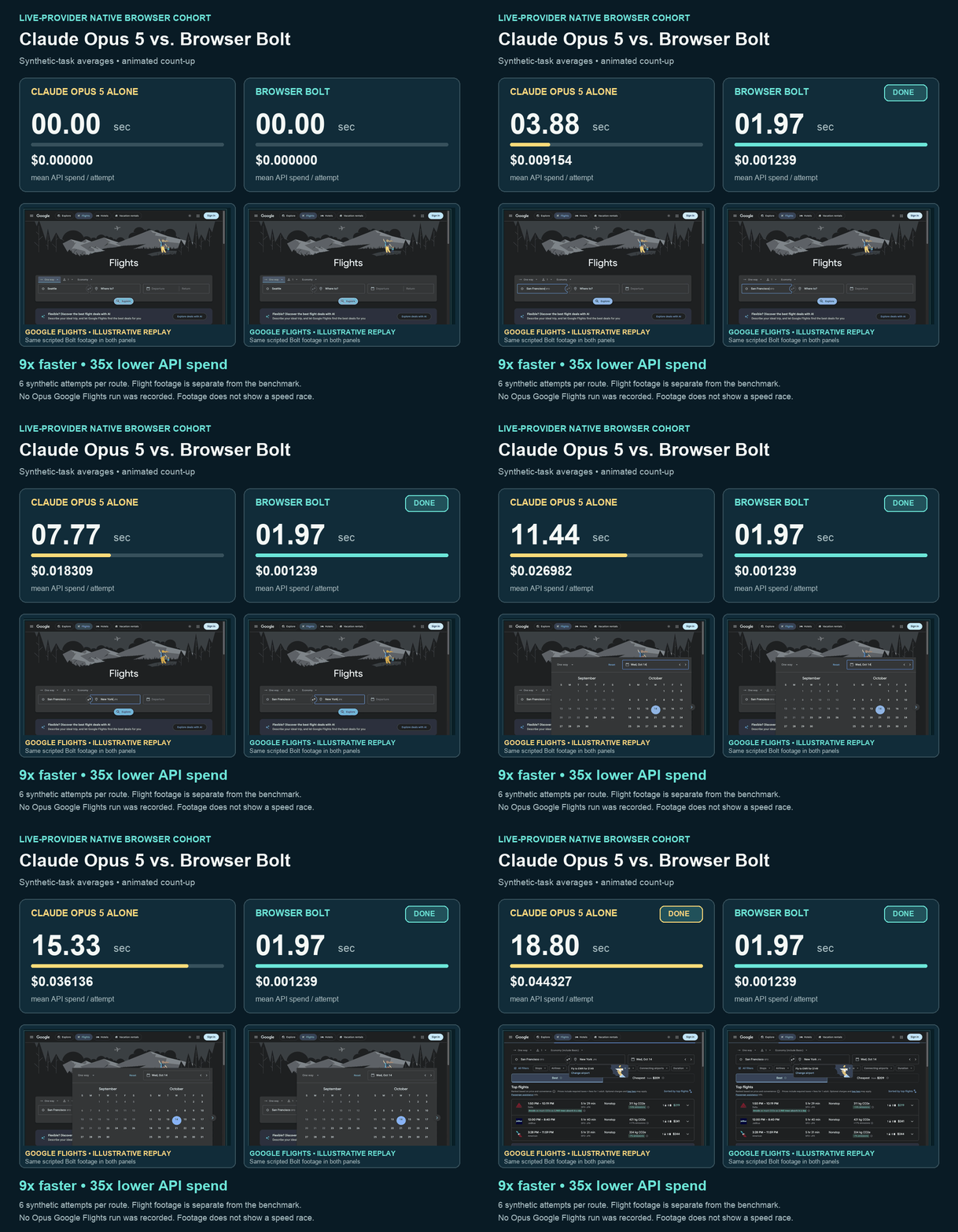
Measured across six synthetic browser attempts per route. “Cheaper” compares API spend only. Methods and limits.
One model picks. One writes.
Jev selects an observed browser action. Qwen on Cerebras writes field text when needed. Your MCP host executes the action and checks the result. Cerebras describes its Wafer Scale Engine as hardware built for low-latency inference.
What the numbers measure
Across six attempts on three synthetic tasks, Claude Opus 5 averaged 18.80 seconds and $0.044327 in API spend; Browser Bolt averaged 1.97 seconds and $0.001239. The benchmark used Jev through OpenRouter for decisions and Cerebras Qwen for writing. It did not time the separate Google Flights clip or today's direct Jev route.
Read the methods and all results